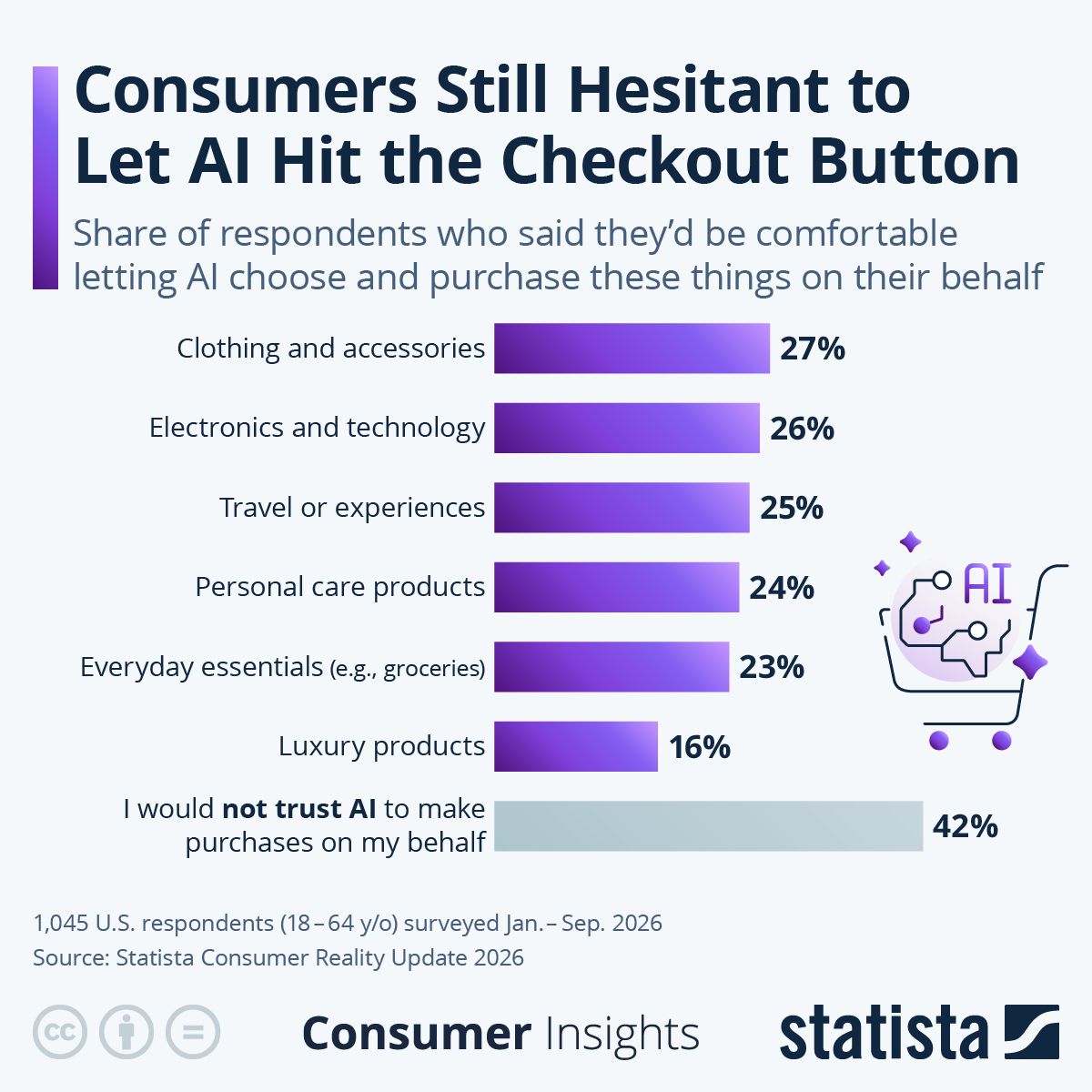
Only 42 percent of surveyed Americans said they would not trust AI to make purchases on their behalf, the largest single share in a Statista Consumer Insights chart on AI shopping agents published October 5, 2026. The chart draws on a survey of 1,045 U.S. respondents aged 18 to 64, fielded from January to September 2026.
Among categories where respondents would feel comfortable letting AI choose and buy items autonomously, clothing and accessories ranked highest at 27 percent. Electronics and technology followed at 26 percent, and travel or experiences at 25 percent. Personal care products drew 24 percent, everyday essentials such as groceries 23 percent, and luxury products the lowest share at 16 percent.
Statista's accompanying text reports that almost 4 in 10 respondents made at least one purchase based on AI recommendations in the past year, and that 48 percent use AI when shopping or researching products often or very often. The gap between those usage figures and the comfort levels with autonomous buying shows that recommendation use has outpaced delegation of the final transaction.
The article adds that everyday essentials may suit AI agents over time because the software could learn a household's buying habits, and that shopping agents would need to build more trust before broader adoption. Statista did not provide exact figures in text for every category, but the chart itself lists all six percentages.
The data concerns consumer attitudes toward autonomous AI actions, which is the area where documented incidents of agents acting against user intent have drawn attention. The survey does not measure such incidents.
Source: Statista -- https://www.statista.com/chart/36668/willingness-to-let-ai-choose-and-purchase-products-autonomously/