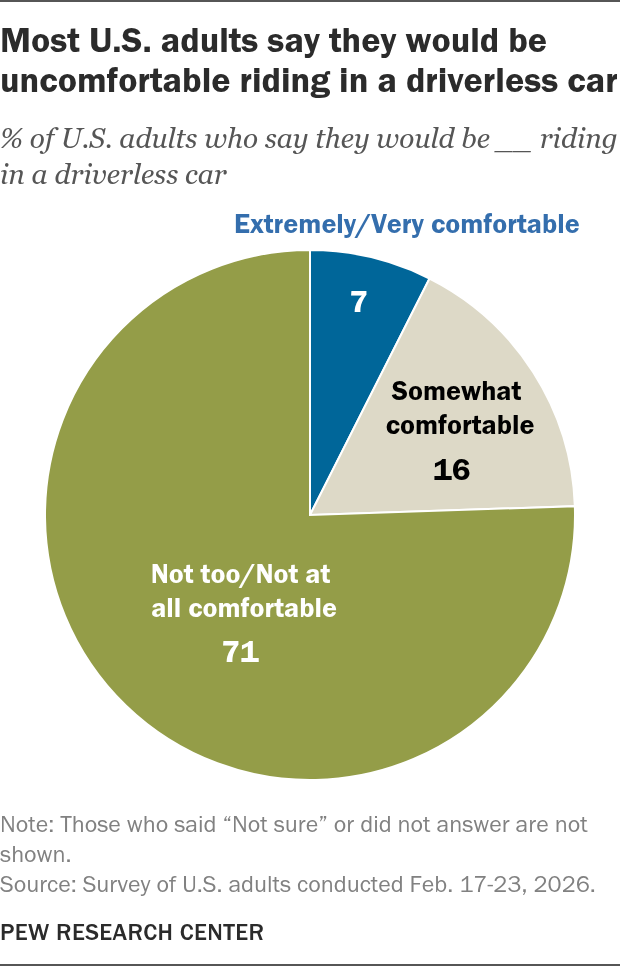
Seventy-one percent of U.S. adults say they would be not too or not at all comfortable riding in a driverless car, according to a Pew Research Center survey of 5,119 adults conducted February 17 to 23, 2026. That total includes 43 percent who say they would be not at all comfortable.
Only 7 percent of respondents say they would be extremely or very comfortable riding in a driverless car, while another 16 percent would be somewhat comfortable. Pew notes that driverless cars belong to a growing list of technologies that use artificial intelligence, relying on cameras and sensors to move through traffic without a human driver.
Direct experience with the vehicles remains limited. Just 5 percent of U.S. adults say they have taken a ride in a driverless car, and more than nine in ten say they have never done so. Pew found that low experience and low comfort levels span age ranges, household income levels and geographic regions.
Prior experience is linked to higher comfort. Four in ten adults who have ridden in a driverless car say they would be extremely or very comfortable doing so again, compared with 5 percent of adults who have never ridden in one.
The survey was conducted as robotaxi operators expanded service in several U.S. cities during 2026, a period that also brought federal crash investigations and service pauses involving autonomous vehicle fleets. Pew noted that public concern about driverless cars is not new: its 2021 survey found Americans were more likely to say widespread use of the vehicles would be bad for society than good.
Source: Pew Research Center -- https://www.pewresearch.org/short-reads/2026/07/01/5-of-americans-say-theyve-ridden-in-a-driverless-car/