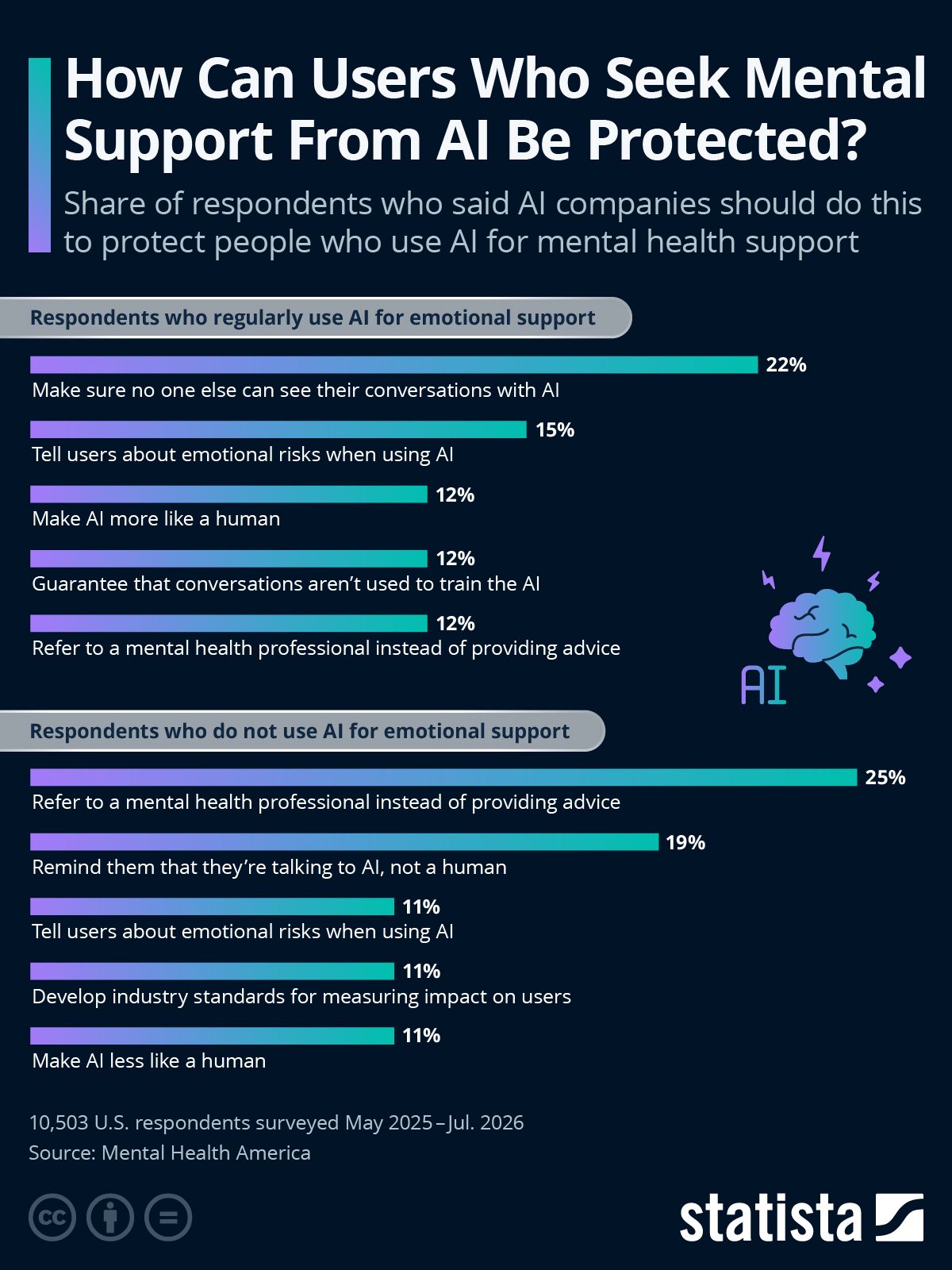
Mental Health America surveyed 10,503 U.S. respondents between May 2025 and July 2026 about how AI companies should protect people who use AI for mental health support. Statista published the results as a chart on October 9, 2026, splitting answers between respondents who regularly use AI for emotional support and those who do not.
Among regular users, 22 percent said companies should make sure no one else can see their conversations with AI. That was the top answer in the group. Another 15 percent chose telling users about emotional risks when using AI. Three options tied at 12 percent: making AI more like a human, guaranteeing that conversations are not used to train the AI, and referring users to a mental health professional instead of providing advice.
Respondents who do not use AI for emotional support ranked the options differently. Referring users to a mental health professional instead of providing advice led at 25 percent. Reminding users that they are talking to AI and not a human followed at 19 percent. Three options tied at 11 percent: telling users about emotional risks, developing industry standards for measuring impact on users, and making AI less like a human.
The two groups placed the referral option at opposite ends of their lists. It drew 12 percent among regular users and 25 percent among non-users. Privacy of conversations led for regular users, while non-users did not list privacy among their top five choices.
The chart credits Mental Health America as the data source and is distributed by Statista under a Creative Commons license.
Source: Statista - https://www.statista.com/chart/36686/how-should-people-who-seek-support-from-ai-be-protected/