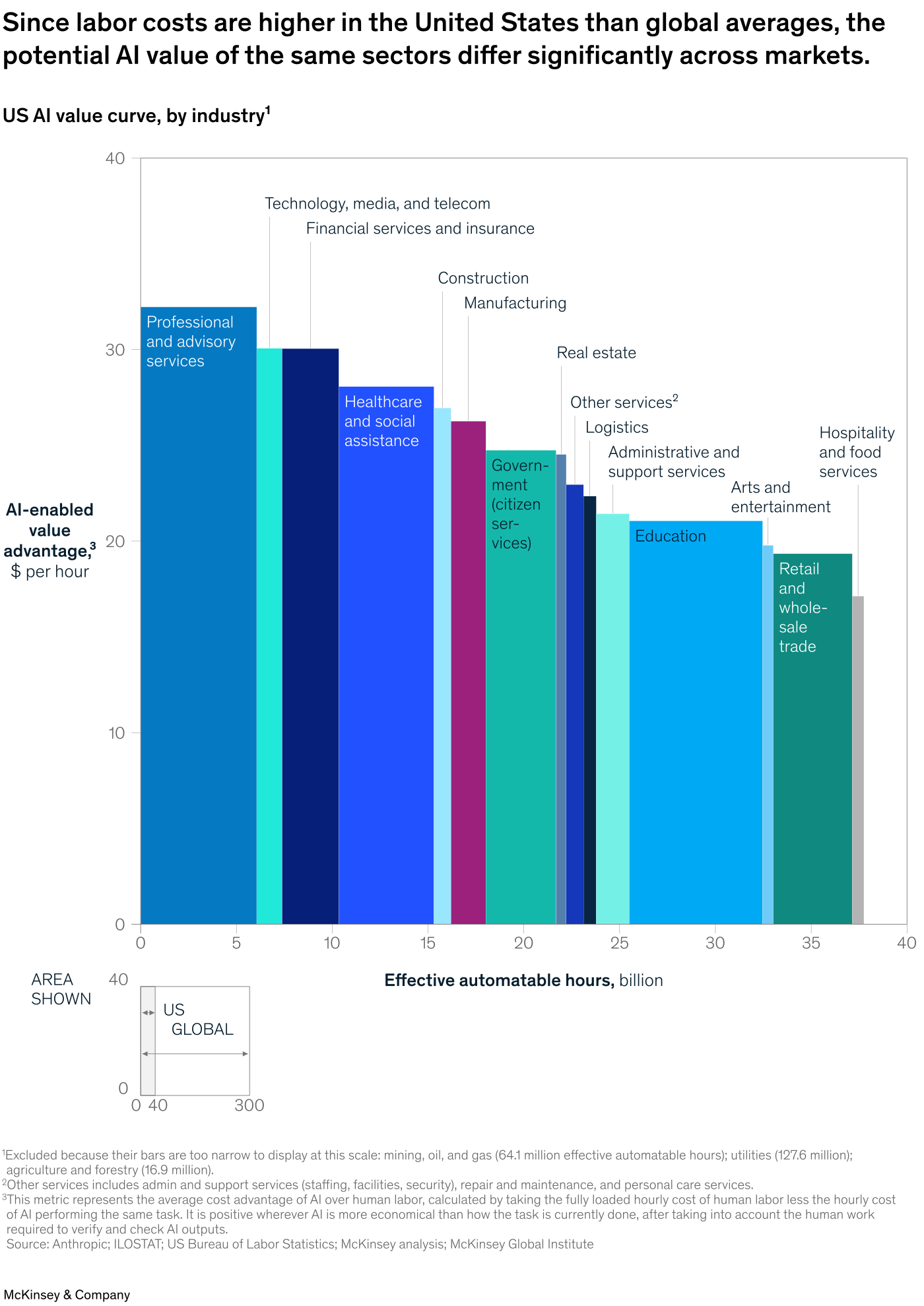
McKinsey & Company published an analysis on October 14 that estimates the annual value of applying AI to existing work across US industries at about $960 billion. The article, titled The AI value curve, models the economics of AI by comparing the fully loaded hourly cost of human labor with the hourly cost of AI performing the same task, after accounting for the human work needed to verify and check AI output.
The US chart plots AI-enabled value advantage in dollars per hour against effective automatable hours, measured in billions. Professional and advisory services show the highest advantage, at roughly 32 dollars per hour. Technology, media and telecom and financial services and insurance follow at around 30 dollars. Healthcare and social assistance sits near 28 dollars, and hospitality and food services sits near the bottom at roughly 17 dollars. The chart shows about 37 billion effective automatable hours across the industries displayed.
McKinsey tested how sensitive the estimate is to AI costs. A 30 percent rise in effective AI cost removes about $320 billion from the US value pool, and the decline reaches all 18 US industries in the model. Higher US labor costs create larger cost differentials, so the same sector looks materially different in the US view than in the global view. The global pool is about $2.52 trillion a year and falls to $1.67 trillion, a 34 percent drop, under the same cost increase.
The analysis also cites about $7 trillion in AI infrastructure capital by 2030, which would require roughly $760 billion in annual profit pools to justify.
Source: McKinsey & Company - https://www.mckinsey.com/capabilities/quantumblack/our-insights/the-ai-value-curve-the-economics-of-applying-ai-to-existing-work