The 2026 Stanford AI Index technical performance chapter tracks how AI systems performed through 2025, with several benchmarks relevant to work automation.
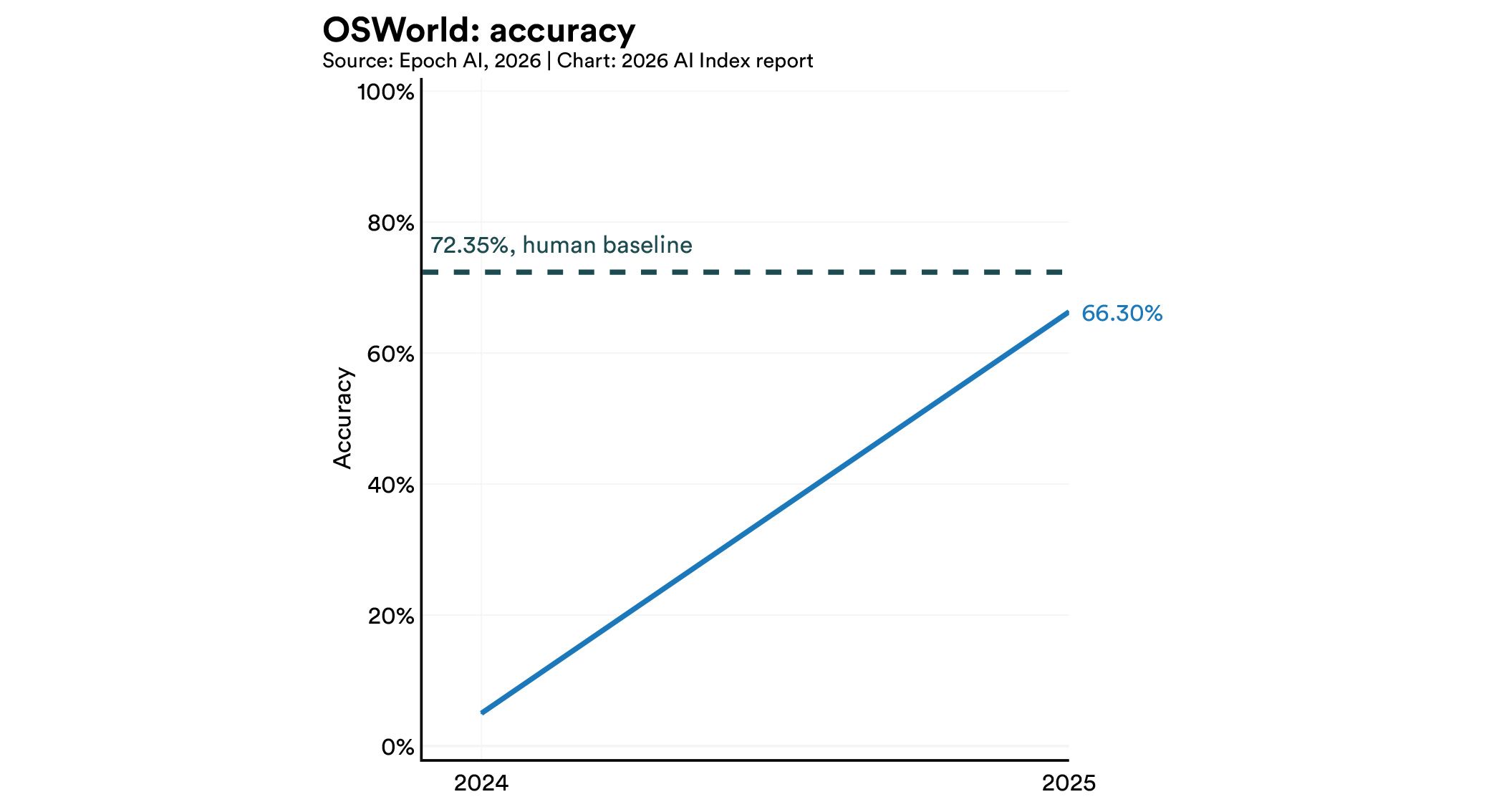
On OSWorld, which tests agents on computer tasks, accuracy rose from about 5 percent in 2024 to 66.3 percent in 2025. The human baseline is 72.35 percent. On ClockBench, GPT-5.4 High leads at 50.6 percent against a human baseline of 90.7 percent.
RLBench, which covers 18 robotic tasks, shows success rates climbing from about 50 percent in 2022 to 89.4 percent in 2025. Waymo's weekly paid trips in California grew from near zero in 2023 to 283,880 in 2025, with a brief dip midyear.
On TaxEval v2, a benchmark based on tax questions, accuracy ranges from 74.20 percent for Kimi K2.5 to 77.11 percent for Claude Sonnet 4.6.
Arena scores, an Elo-like ranking of model quality, put Anthropic first among providers at 1,503, followed by xAI at 1,495 and Google at 1,494. Meta ranks lowest of the providers listed at 1,335. Closed models lead open models throughout the period, reaching 1,503 against 1,454 for the top open model in 2026. U.S. models also lead, with a top score of 1,503 against 1,464 for the top Chinese model.
The accompanying chart plots OSWorld accuracy by year against the human baseline.
Source: Stanford HAI AI Index - https://hai.stanford.edu/ai-index/2026-ai-index-report/technical-performance