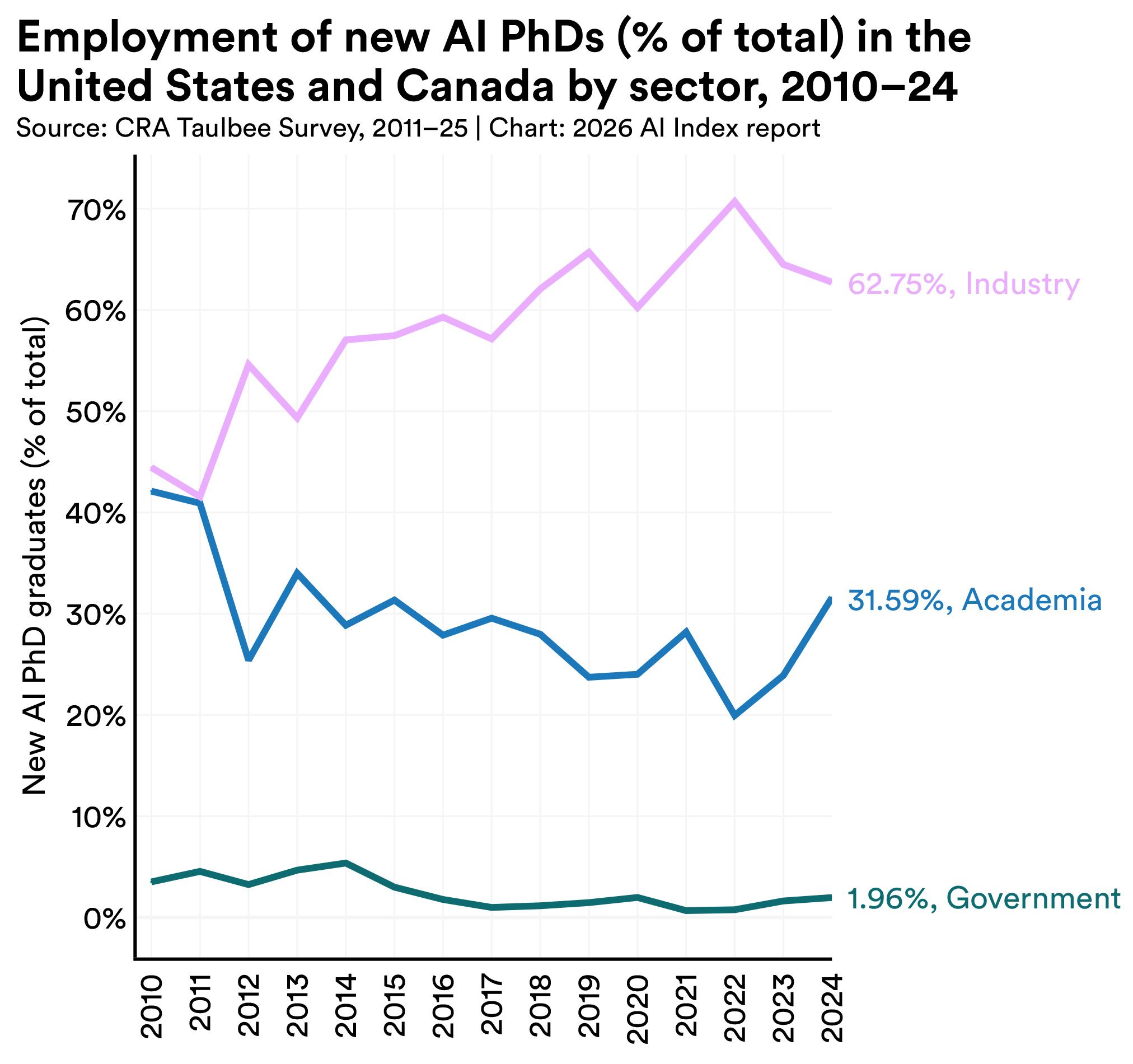
The 2026 Stanford AI Index education chapter tracks the talent pipeline behind AI deployment. Its chart of employment sectors for new AI PhDs in the United States and Canada, covering 2010 to 2024, shows industry employing the largest share at 62.75 percent in 2024. Academia follows at 31.59 percent, and government stays below 5 percent across the full period.
The number of new AI PhDs in the two countries rose 22 percent from 2022 to 2024. All of that growth went to academia, which reverses a decade-long pattern of new PhDs flowing mainly into industry roles, and the share heading to industry has stayed flat.
Other findings in the chapter cover degree-level supply. Computer science enrollment fell 11 percent at U.S. four-year universities between 2024 and 2025, while master's graduates in AI software-related fields rose 17 percent from 2023 to 2024. The United States recorded the highest number of new information, communications and technology bachelor's graduates in both 2022 and 2023, followed by Brazil. Turkey, Brazil and Mexico have increased ICT graduate output more rapidly in recent years.
The chapter also reports that people are acquiring AI skills outside formal education and listing them on resumes, with AI literacy growing faster than engineering-oriented AI skills in most countries.
Source: Stanford HAI AI Index - https://hai.stanford.edu/ai-index/2026-ai-index-report/education