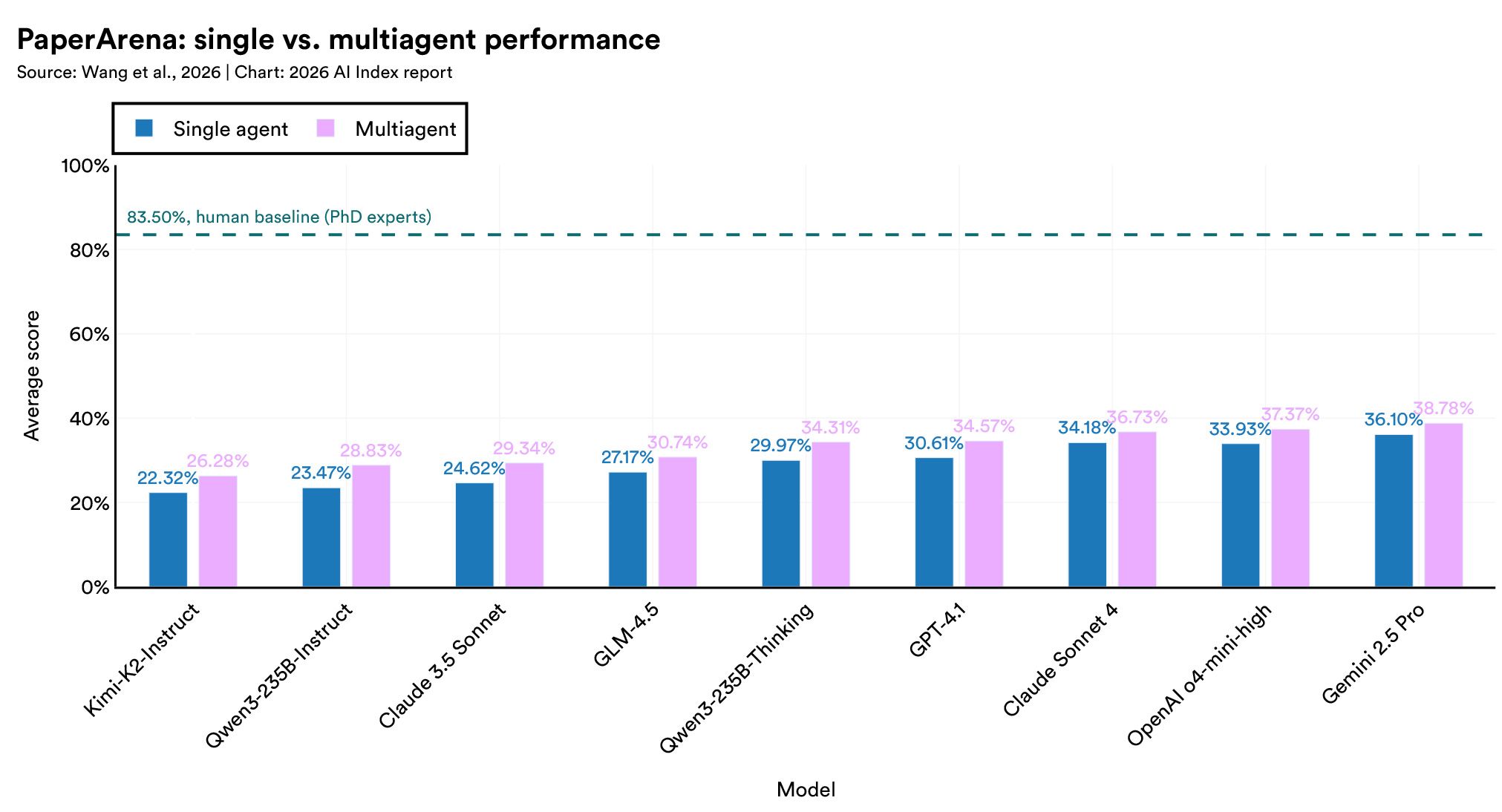
The 2026 Stanford AI Index science chapter includes a bar chart of PaperArena average scores for single-agent and multiagent AI systems across nine models. Multiagent performance exceeds single-agent performance for every model tested. Gemini 2.5 Pro posts the highest score at 38.78 percent, compared with a PhD expert baseline of 83.50 percent.
Other agent benchmarks in the chapter show a similar gap. On BixBench, frontier models reach roughly 17 percent accuracy on real-world bioinformatics analysis. On ReplicationBench, they score below 20 percent on paper-scale replication in astrophysics. On UnivEarth, LLM agents answer earth observation questions with 33 percent accuracy, and their code fails 58 percent of the time.
The chapter also reports growth in AI-related research. Natural sciences produced approximately 80,150 AI-related publications in 2025, up 26 percent from 2024, split across 33,050 in physical sciences, 28,910 in life sciences and 20,460 in earth science. AI now accounts for 5.8 percent to 8.8 percent of scientific research output depending on the field, up from below 1 percent in 2010.
AI-generated research also reached a milestone in 2025, when a paper produced by Sakana's AI Scientist-v2 was accepted at an ICLR workshop, though the list of experimentally confirmed AI discoveries remains short.
Source: Stanford HAI AI Index - https://hai.stanford.edu/ai-index/2026-ai-index-report/science