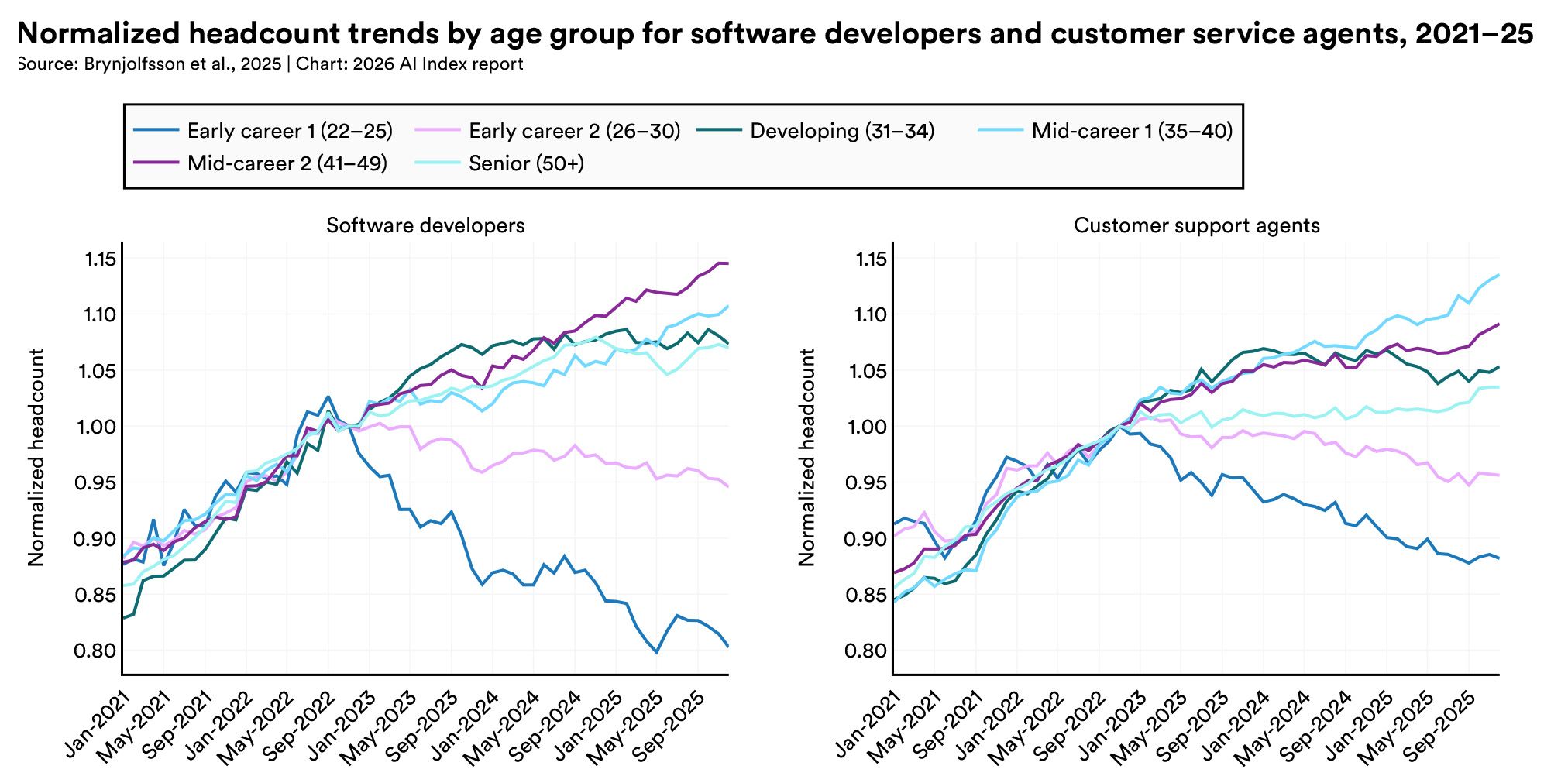
Employment declines among younger workers in AI-exposed occupations continued into 2026, led by customer service, and have now deepened in roles where AI supports human work, such as marketing managers and IT managers. That finding comes from a November 15, 2026 update by Sha Sajadieh, editor of Stanford HAI's AI Index, drawing on the Stanford Digital Economy Lab's AI Economic Indicators. The author notes that these patterns do not establish that AI caused the declines.
The 2026 AI Index report set the baseline for that trend. Its economy chapter charts normalized headcounts from 2021 to 2025 for software developers and customer support agents, based on research by Brynjolfsson and colleagues. Headcounts fell for workers aged 22 to 25 in both occupations, while most older age groups grew over the same period.
The update pairs the labor signals with a sharp rise in spending. Global corporate investment in AI had surpassed $1 trillion in 2026 by the time of writing, already exceeding the entire 2025 total by 46%.
Public views remain divided. In the United States, 60% of adults say they would feel uncomfortable with a new data center in their area. In every country surveyed, more people expect AI to eliminate jobs than create them, although a global majority still believes AI's benefits outweigh its drawbacks.
Employer expectations from the 2026 report point the same direction. Among organizations surveyed by McKinsey about the coming year, 43% expected little or no change in workforce size from AI, 32% expected a decrease, and 13% expected an increase.
The next AI Index is scheduled for release in April 2027.
Source: Stanford HAI -- https://hai.stanford.edu/news/the-jagged-edge-of-the-ai-boom