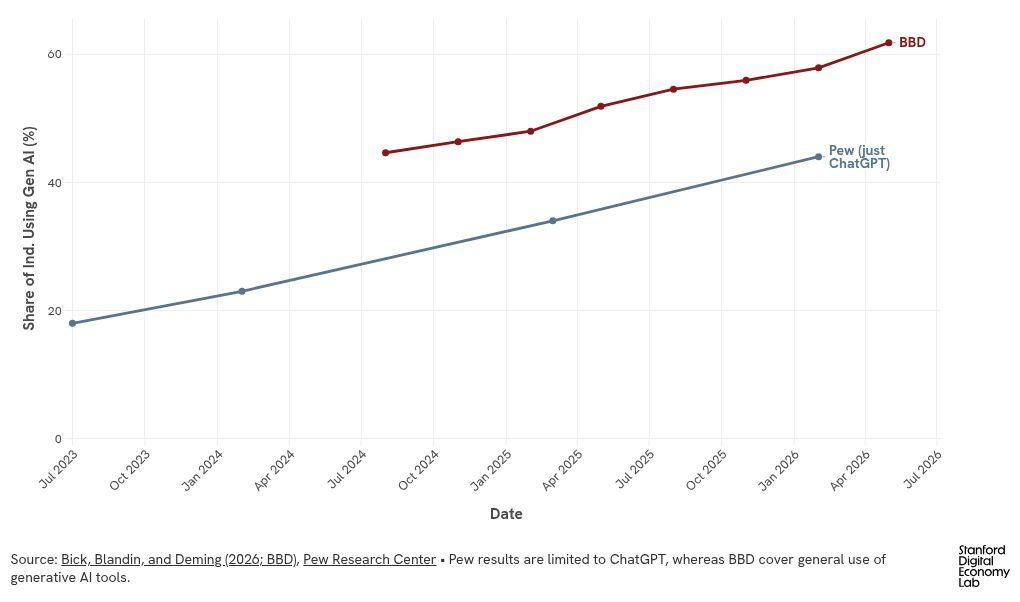
Self-reported use of generative AI among individuals in the United States reached 62% in May 2026, according to the Adoption Monitor maintained by the Stanford Digital Economy Lab, last updated November 18, 2026. The figure comes from survey work by economists Bick, Blandin and Deming, whose series in the lab's chart has risen steadily since 2024 across work and personal use.
Frequency data shows a gap between trying the tools and relying on them. Nearly 90% of generative AI users say they use the tools every week, but only about a quarter report using them every day.
Measures of workplace use are less consistent. Surveys from Gallup and from Bick, Blandin and Deming show adoption for work continuing to rise toward 50%, while a separate study by Hartley and coauthors reports a decline.
At the firm level, the tracker draws on a survey of senior executives in the U.S., the UK, Germany, Australia, Canada, Mexico and South Africa conducted between May and July 2026. U.S. firms reported the highest current AI adoption among those countries, while firms in Mexico and South Africa reported the lowest. Across applications other than generative AI, firms expect adoption to rise over the next three years, with data processing using machine learning and with robotics and autonomous vehicles showing the largest gaps between current and expected use.
Generative AI is the exception. Firms in most of the surveyed countries forecast decreases in generative AI adoption, led by companies in the U.S., the UK and Germany. On net, 4% of firms expect to move from using no AI technology to using it. The firm data comes from NBER Working Paper 34836 by Yotzov, Barrero, Bloom and coauthors.
Source: Stanford Digital Economy Lab -- https://digitaleconomy.stanford.edu/project/indicators/adoptionmonitor/