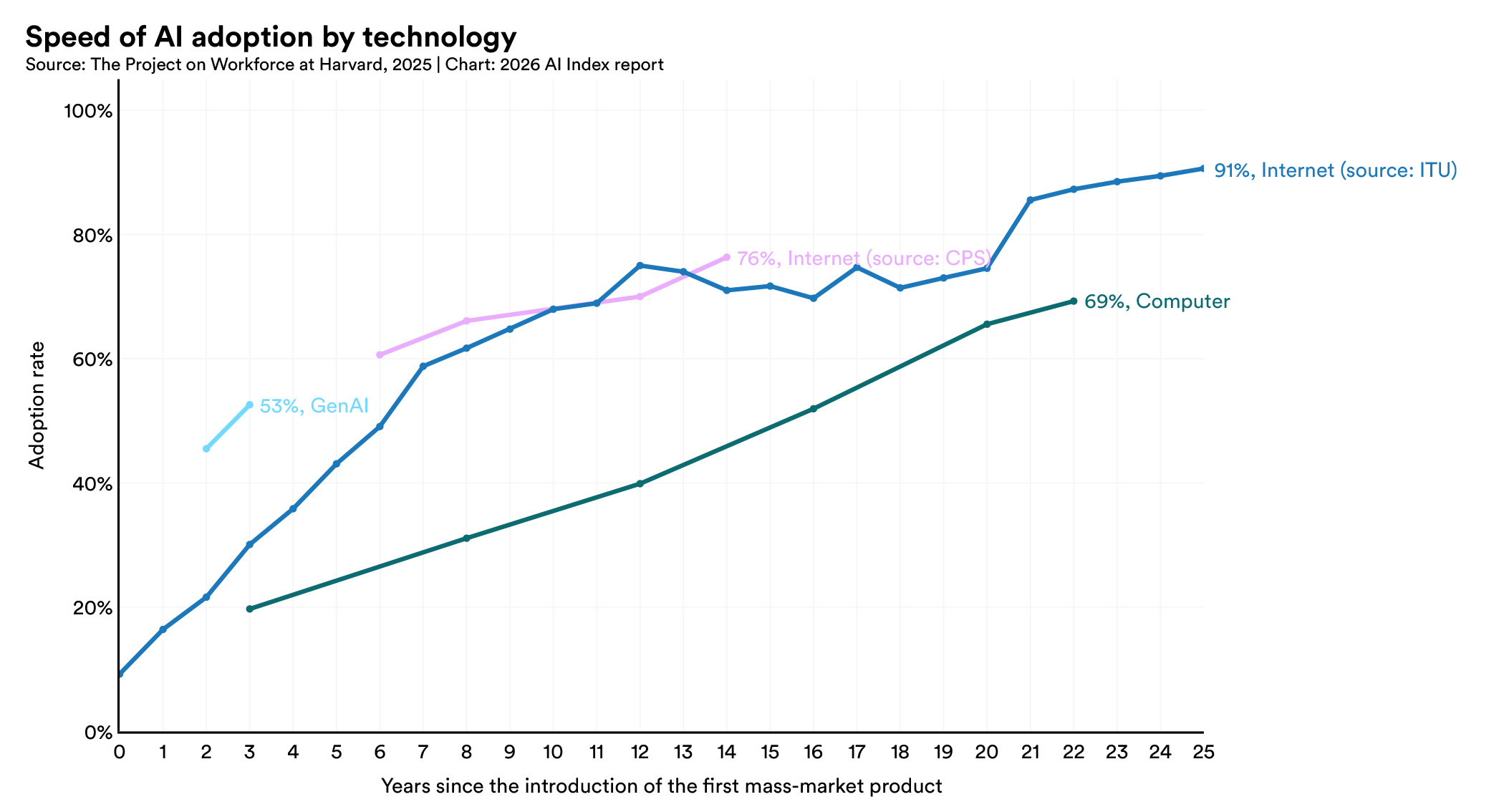
The 2026 Stanford AI Index Report documents AI adoption reaching 88% of organizations globally using AI in at least one business function, with 4 in 5 university students now using generative AI tools. The report found generative AI reached 53% population adoption within three years of broad availability, a faster uptake than either the personal computer or the internet.
AI capability advances accelerated sharply in 2025. On the SWE-bench Verified coding benchmark, model performance rose from 60% to near 100% in a single year. AI agents improved from 12% to roughly 66% task success on real computer tasks. Industry produced over 90% of notable frontier models, and several now meet or exceed human baselines on PhD-level science questions.
U.S. private AI investment reached $285.9 billion in 2025, more than 23 times China's $12.4 billion, with 1,953 newly funded AI companies in the US alone. Estimated U.S. consumer surplus from generative AI tools reached $172 billion annually by early 2026, with the median value per user tripling between 2025 and 2026. The report also flagged that documented AI incidents rose to 362 in 2025, up from 233 in 2024, as responsible AI benchmarking continues to lag capability development.