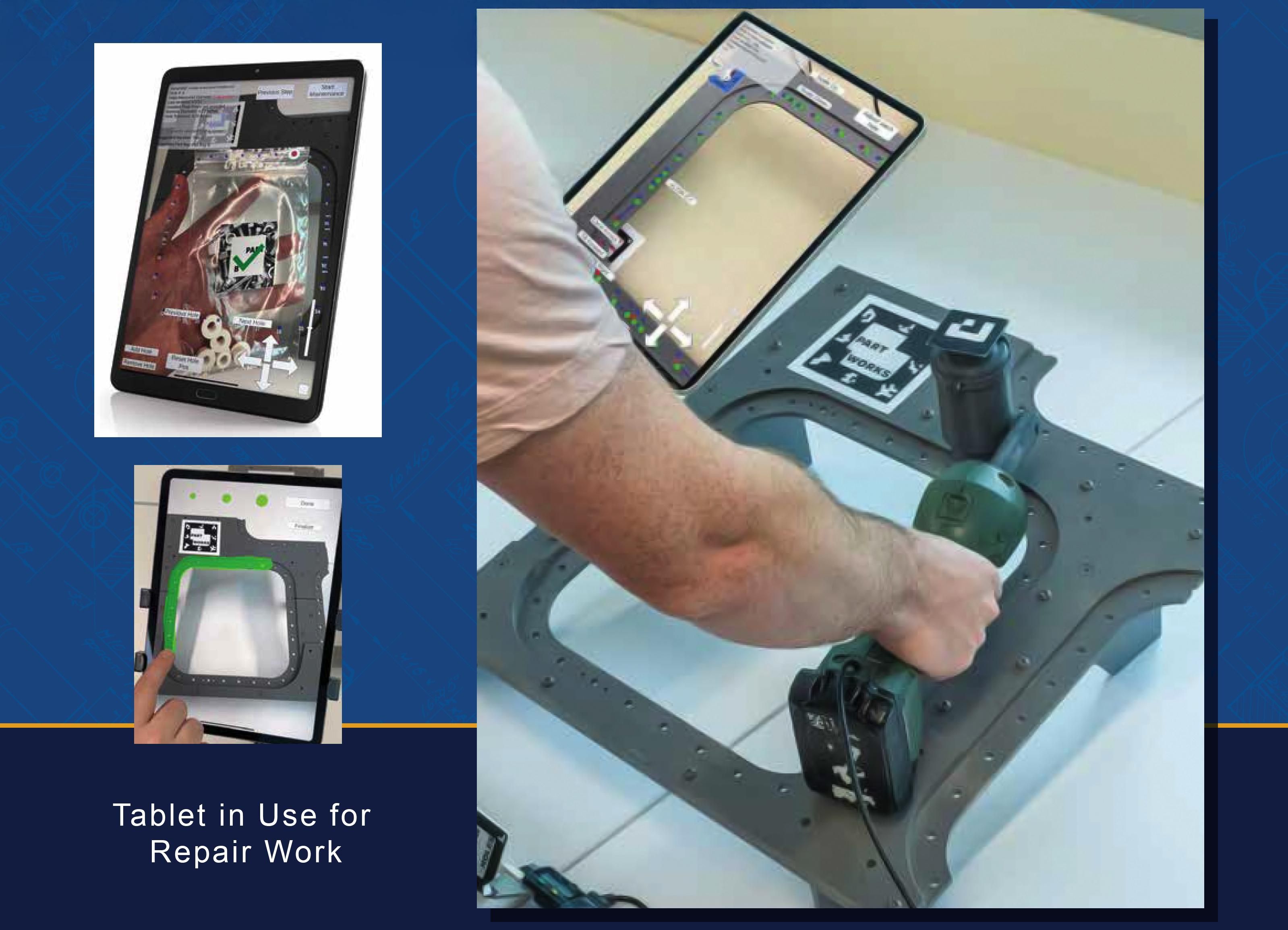
Three years after a research collaboration began between Atlanta aerospace engineering firm PartWorks and Georgia Tech's Institute for People and Technology, the results are concrete: multiple patented and patent-pending solutions, a commercial AR product launched at the world's largest MRO conference, and a multiyear contract with the Air Force Research Lab (AFRL) in Dayton, Ohio. The story of how this partnership developed is a model for what university-industry research in aerospace technology can look like when structured for real operational outcomes rather than academic publication alone.
PartWorks, founded and led by CEO Scott Geller, is an Atlanta-based firm dedicated to extending the life and improving the operational efficiency of commercial and military aircraft and spacecraft. Its core focus is structural repair -- specifically the cold expansion and hole repair processes that determine whether aging aircraft can remain safely in service and qualify for life extension credit. The challenge PartWorks brought to Georgia Tech in 2022 was precise in its framing: how do you take the precision requirements of FAA-governed structural aircraft repair and make them reliably executable by a broader range of technicians, with better documentation, less rework, and faster cycle times?
The answer, developed over three years with Maribeth Gandy Coleman and her IPaT research team, is a combination of augmented reality guidance, computer vision-based validation, and machine learning -- assembled into RepAR, an integrated AR maintenance platform. RepAR overlays repair instructions into a technician's field of view, captures dimensional data in real time, validates each step against required specifications, and logs the complete repair record digitally. The result is a system where technology absorbs the procedural compliance burden, freeing the technician to focus on execution quality.
Geller has spoken directly about what the Georgia Tech partnership delivered that a purely commercial R&D path would not have made possible.
"I could not have hired anybody with the diverse skill sets that both Maribeth and the Georgia Tech team brought to bear," said Geller. "We've utilized different and complicated skill sets, sometimes in small quantities, that have made our project work very cost-effective. We've used an iterative research and development process that hasn't had a shocking cost or huge surprises. And the Georgia Tech team has been both easy and fun to work with, too."
For Coleman, the PartWorks engagement is precisely the kind of translational research IPaT was built to produce -- taking 25 years of fundamental academic work in extended reality and deploying it into a context where it generates measurable operational improvement in the field. Her background spans mobile and wearable computing, augmented reality, human-computer interaction, and assistive technology -- a cross-disciplinary portfolio that maps directly onto the human factors challenges at the heart of aircraft maintenance quality.
"This collaborative research with industry demonstrates why Georgia Tech has interdisciplinary research institutes such as IPaT, and why you have research faculty," said Coleman. "You're probably not going to be able to get some Ph.D. students to do this work. The focus here with PartWorks is on translation. It's cross-disciplinary collaboration and translation built on augmented reality work we've been doing for 25 years and implementing cutting-edge technology crafted to the right context to support aircraft maintenance."
The AFRL contract adds a dimension that goes beyond commercial product development. The Air Force Research Lab relationship means PartWorks and Georgia Tech are simultaneously advancing RepAR for military readiness applications -- aircraft availability, maintenance cycle reduction, and quality assurance for aging fleets -- under the support of the primary federal R&D organization for U.S. air power. The partnership has attracted commercial attention from military and commercial aviation OEMs, established MRO providers, and space industry companies, broadening the addressable market well beyond the original structural repair use case.
"This Georgia Tech collaboration and augmented reality MRO research and development are in conjunction with a multiyear contract we're working on with the Air Force Research Lab in Dayton, Ohio," said Geller. "We're appreciative of their partnership and excited to be getting commercial interest in RepAR from both military and commercial aviation OEMs and MROs as well as space industry companies."
The RepAR system represents what is described as the world's first AR-capable, high-performance handheld cold expansion tool -- a device that collects real-time data from each repair, ensures accuracy, and validates and documents the process to support life extension credit for the aircraft. That documentation capability alone addresses one of the persistent pain points in aging fleet management, where proof of repair quality determines whether an airframe remains in service or moves to early retirement.
Source: Georgia Tech Research -- https://research.gatech.edu/transforming-aircraft-maintenance-augmented-reality