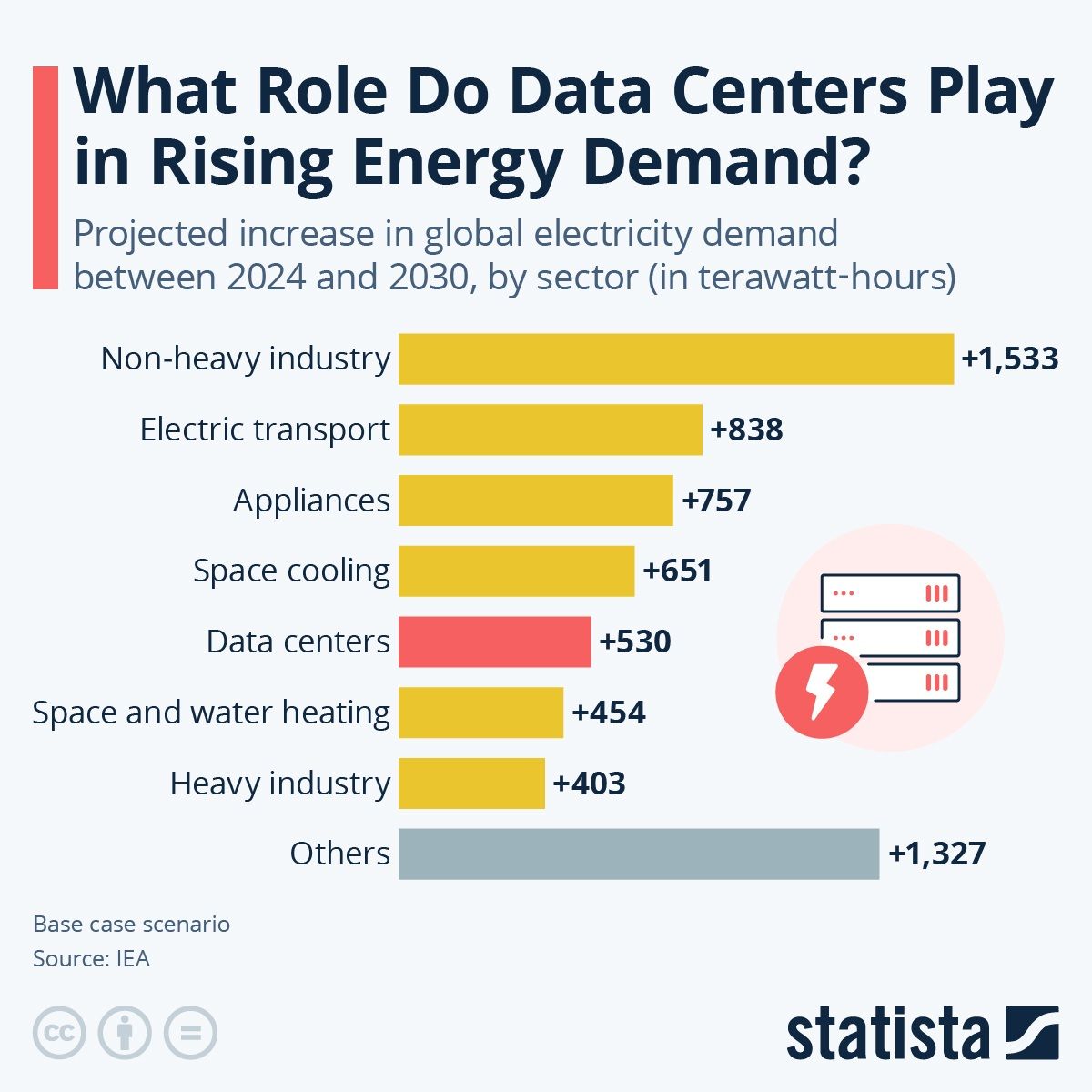
The International Energy Agency projects that data centers will account for an additional 530 terawatt-hours of global electricity demand between 2024 and 2030 in its base case scenario. A Statista chart built on the IEA figures ranks data centers fifth among the sectors driving growth.
The chart lists the projected increase by sector in terawatt-hours. Non-heavy industry leads at 1,533, followed by electric transport at 838, appliances at 757, and space cooling at 651. Data centers come next at 530, ahead of space and water heating at 454 and heavy industry at 403. Other sectors combined add 1,327.
The totals put the data center increase at about 8 percent of the projected rise in global electricity demand through 2030. Statista expresses the scale in household terms. The 1,533 terawatt-hours for non-heavy industry matches the annual electricity use of around 145 million average U.S. households, while the 530 terawatt-hours for data centers matches the annual use of about 50 million households.
The IEA also models other paths. In a scenario with faster AI adoption, the data center share of the demand increase could reach as high as 12 percent by 2030, and data centers could make up as much as 4.4 percent of overall global electricity demand by 2035. A scenario with stronger energy efficiency puts that 2035 share at 2.6 percent, and a scenario where AI use stays near current levels keeps it below 2 percent.
The base case places data center consumption at 1.5 percent of global electricity use today and 3.2 percent in 2035. The chart was published by Statista in March 2026 using IEA data.
Source: Statista - https://www.statista.com/chart/36004/data-centers-rising-energy-demand/