Data centers already consume more than 10% of the electricity supply in six U.S. states, with Virginia leading at 25%, according to the International Energy Agency's Energy and AI report. The finding appears in the report's section on the links between energy and artificial intelligence, which describes data centers as highly concentrated in spatial terms.
That concentration stands out against the global picture. The IEA estimates that data centers consumed around 1.5% of the world's electricity in 2024. The gap between that worldwide average and the state level shares shows how clustered the facilities are and why their effect on some regional grids is far larger than national totals suggest.
Facility size is also rising. A conventional data center may draw around 10 to 25 megawatts, according to the IEA, while a hyperscale, AI focused data center can have a capacity of 100 megawatts or more and use as much electricity each year as 100,000 households. The agency adds that the size of the largest data centers is increasing.
High local shares are not limited to the United States. In Ireland, data centers consume around 20% of the metered electricity supply. By contrast, emerging market and developing economies outside China hold more than two thirds of the world's population but less than a third of global electricity generation and less than 10% of data center capacity.
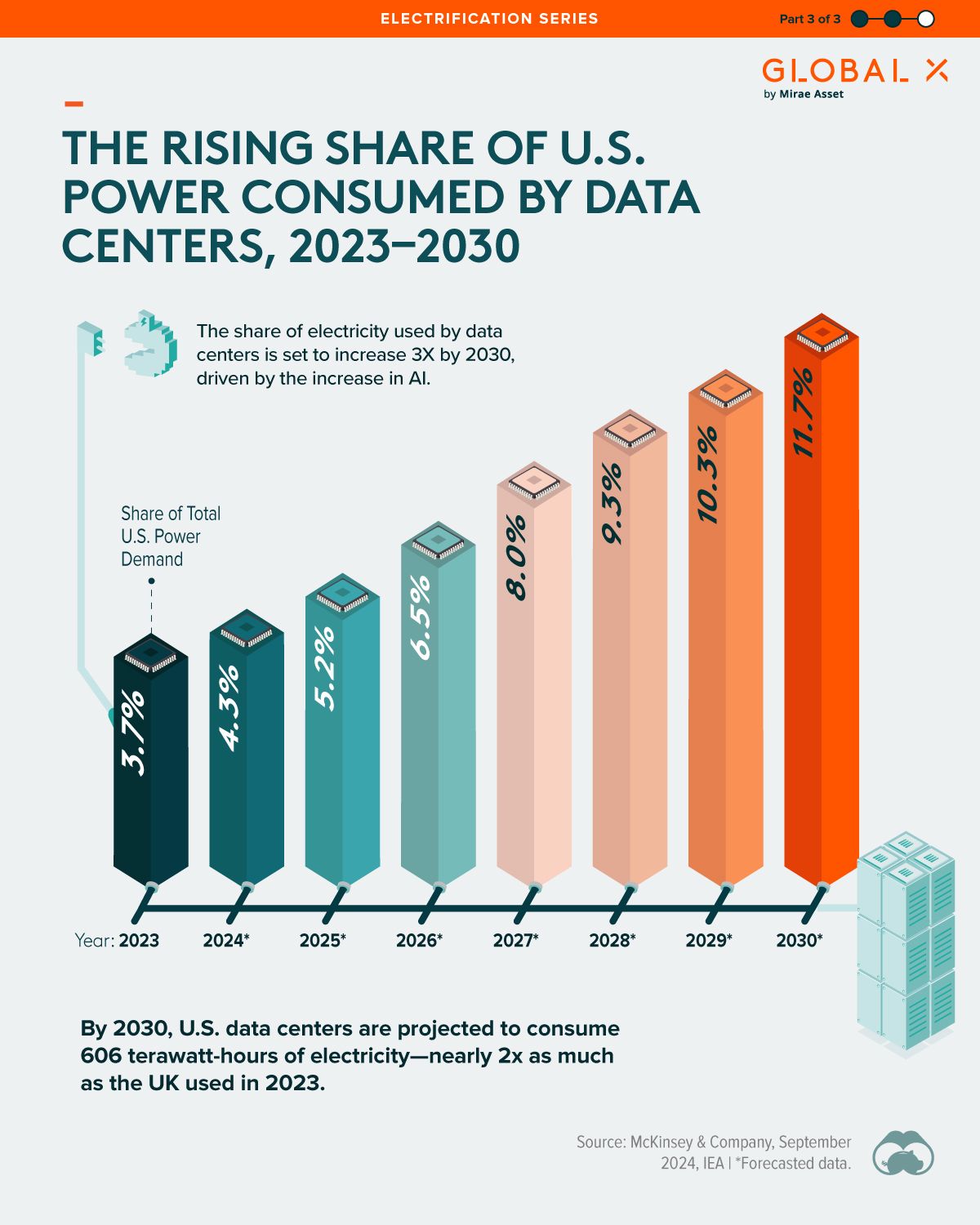
The accompanying chart from Visual Capitalist, based on McKinsey and IEA data, shows the data center share of total U.S. power demand rising from 3.7% in 2023 to a projected 11.7% in 2030, when U.S. data centers are projected to consume 606 terawatt hours of electricity.
Source: International Energy Agency -- https://www.iea.org/reports/energy-and-ai/understanding-the-energy-ai-nexus