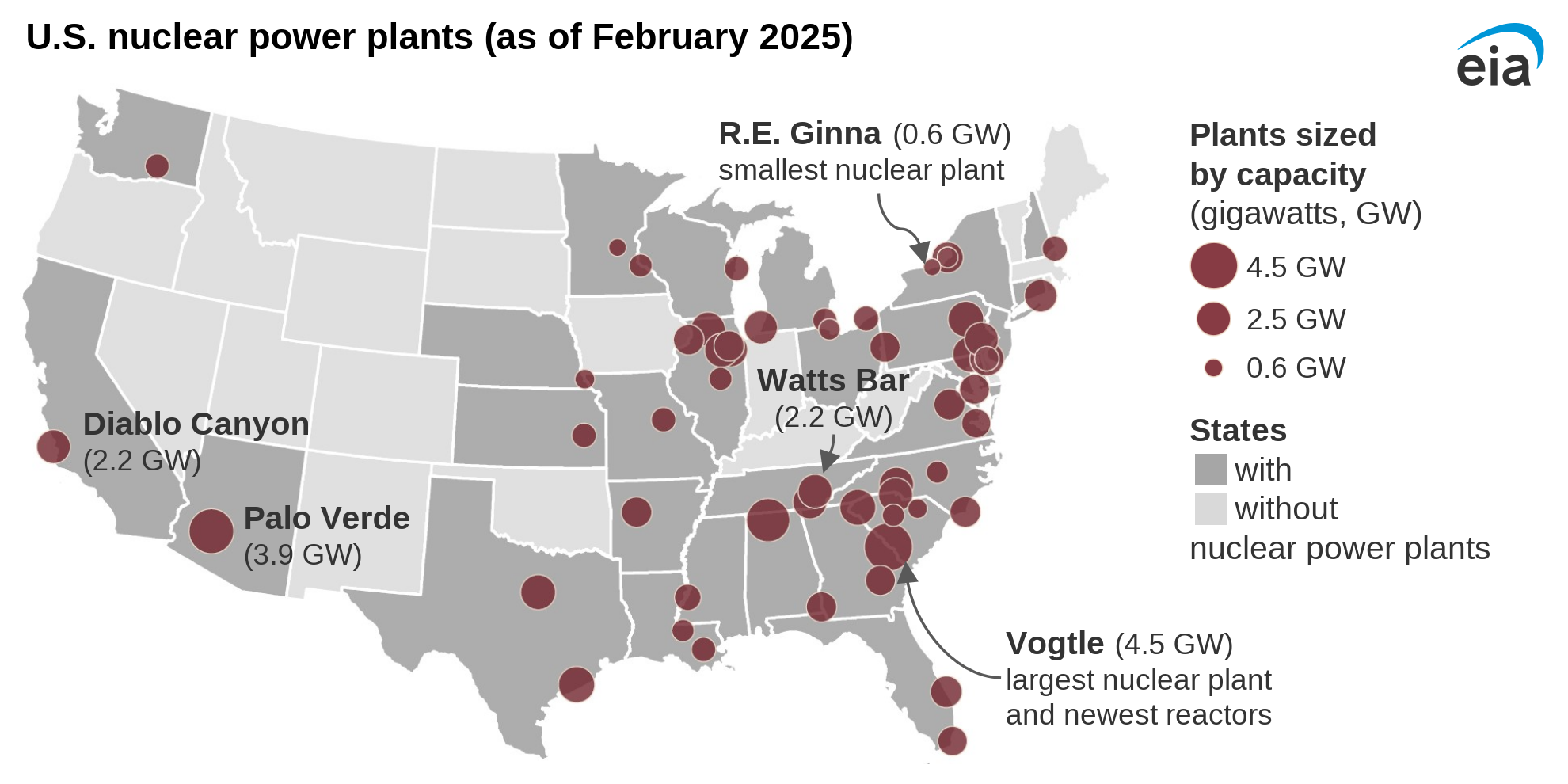
The US Energy Information Administration reports that US utilities operated 94 nuclear reactors in 2024 with a combined net generating capacity of nearly 97 gigawatts, the largest commercial nuclear fleet in the world. The reactors sit at 54 power plants, each with one to four operating units, and supply 19 percent of power sector electricity generation.
Other countries trail the US fleet by a wide margin. France operates 57 units totaling 63.0 gigawatts, China 57 units at 55.3 gigawatts and Russia 36 units at 28.6 gigawatts.
Plant Vogtle in Georgia is the largest US nuclear plant at about 4.5 gigawatts across four reactors. Units 3 and 4 each add 1.1 gigawatts, after Georgia Power brought one online in 2023 and another in 2024. Palo Verde in Arizona follows at 3.9 gigawatts. The R.E. Ginna plant in New York is the smallest at 0.6 gigawatts. Diablo Canyon in California and Watts Bar in Tennessee each carry 2.2 gigawatts.
The two Vogtle reactors and one reactor at Watts Bar are the only new units to come online in the United States since 1996. Twelve reactors have permanently closed since 2013.
EIA's chart of capacity and generation from 2010 to 2024 shows capacity peaking in 2012 and generation peaking in 2019. Generation reached 782 billion kilowatthours in 2024. EIA attributes consistently high capacity factors to shorter refueling and maintenance outages and improved operating experience.
EIA also notes that the Department of Energy provided credits in January 2024 to support continued operation of Diablo Canyon, and approved a loan to support a restart of the Palisades plant in Michigan.
Source: U.S. Energy Information Administration - https://www.eia.gov/todayinenergy/detail.php?id=65104