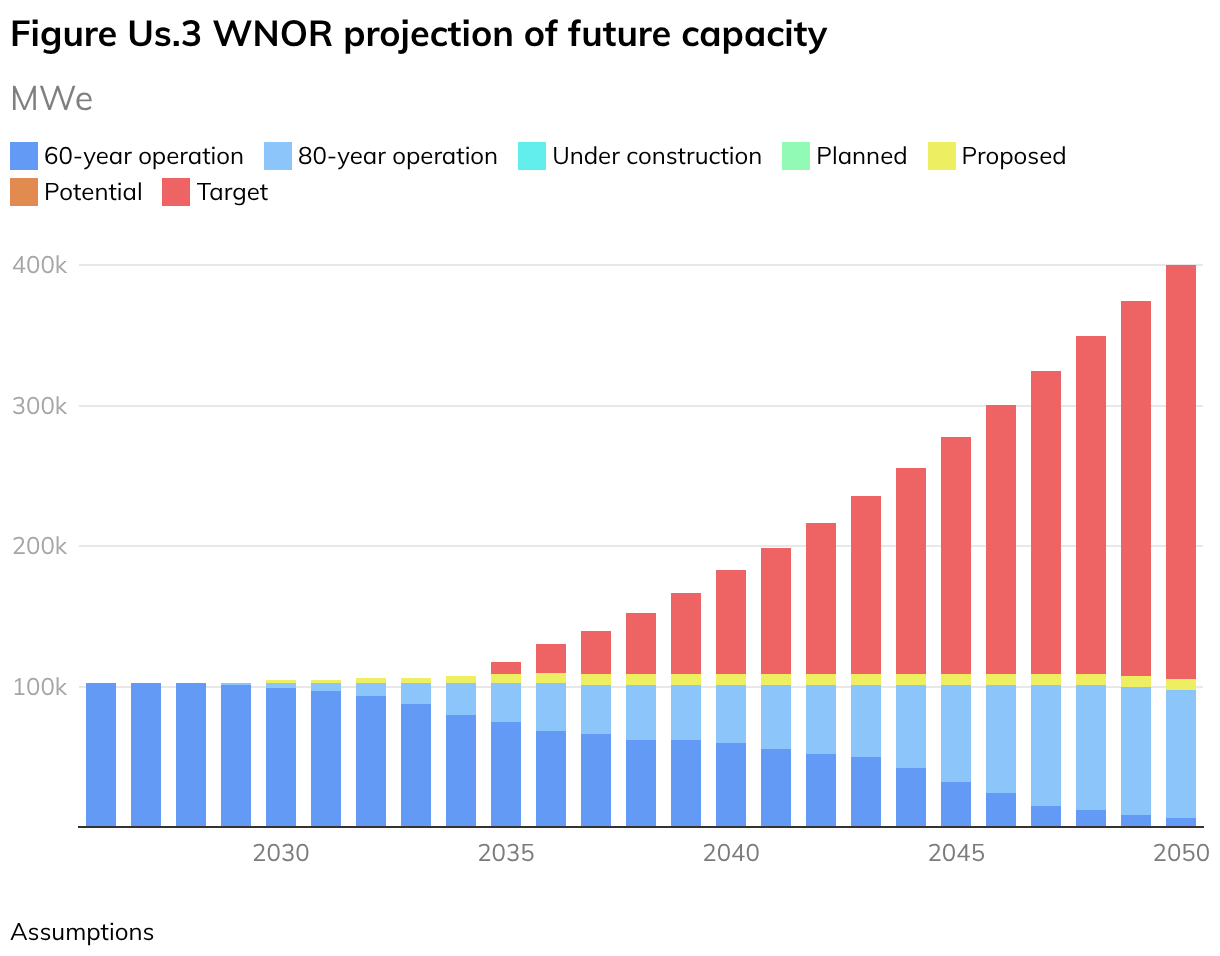
The United States would need about 294,865 MWe of nuclear capacity beyond everything now operating, proposed or under study to reach the federal goal of 400,000 MWe by 2050, according to the World Nuclear Association's country profile in its World Nuclear Outlook Report, updated October 16, 2026. The association said almost 300 GWe of the 400 GWe objective has no attributable project.
As of October 1, 2026, the country had 94 operable reactors with 96,952 MWe of net capacity and 102,475 MWe of gross capacity. Most of those units were built between 1967 and 1990. In its 2050 projection, the association credits 91,417 MWe to reactors running for 80 years, 6,178 MWe to reactors operating on 60-year licenses and 7,540 MWe to proposed projects.
License extensions carry much of that outlook. Nearly every US reactor has had its original 40-year license extended to 60 years, and as of October 2026 the Nuclear Regulatory Commission had approved subsequent renewals, which allow operation to 80 years, for 25 reactors. The report's capacity chart shows the existing fleet holding near 100 GWe into the 2030s, with the gap to the target widening after 2035.
The profile also tracks new construction steps. The NRC issued TerraPower a construction permit for a Natrium plant in Wyoming in March 2026 and issued TVA a permit for a BWRX-300 at Clinch River, Tennessee, in September 2026. In June 2026 the Department of Energy announced conditional commitments of up to $17.5 billion in loans for long-lead procurement for up to five two-unit AP1000 projects. Executive orders signed in May 2025 call for 5 GWe of uprates and 10 large reactors under construction by 2030.
Source: World Nuclear Association -- https://world-nuclear.org/our-association/publications/world-nuclear-outlook-report/united-states-of-america---world-nuclear-outlook-report