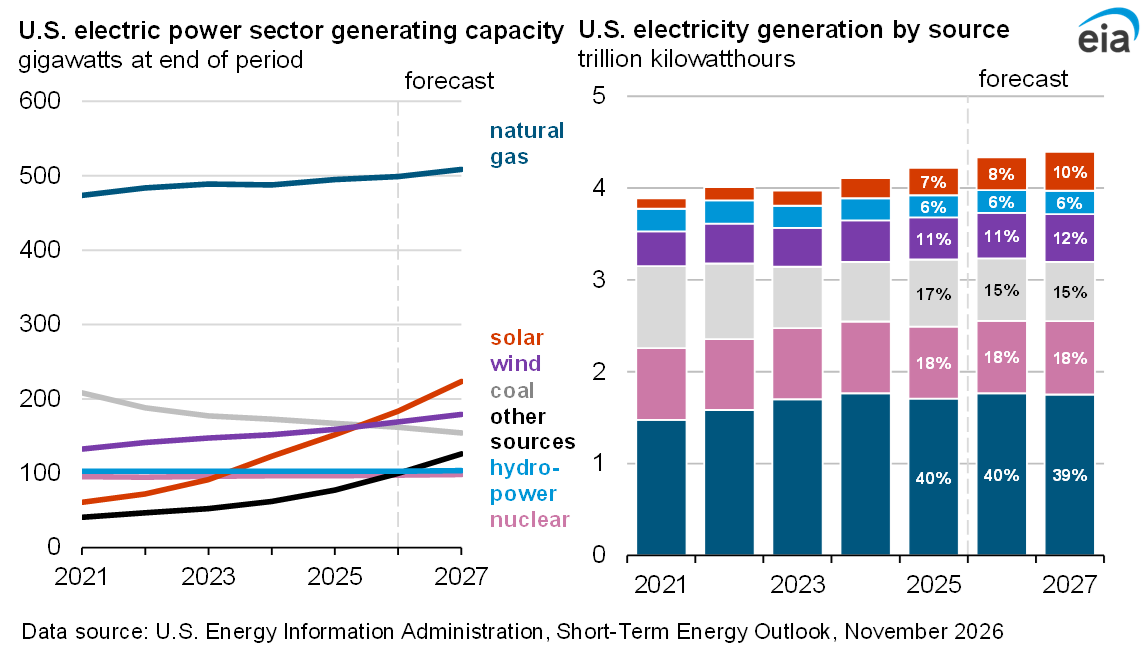
The U.S. electric power sector held about 96.9 gigawatts of nuclear generating capacity at the end of 2025, and the Energy Information Administration expects that figure to reach about 97.6 GW at the end of 2026 and 98.4 GW at the end of 2027, according to data behind its November 2026 Short-Term Energy Outlook.
The EIA chart pairs generating capacity with generation by source, and the comparison highlights how much electricity the nuclear fleet produces per gigawatt. Nuclear plants are forecast to supply about 18% of U.S. electric power sector generation in 2026 from under 98 GW of capacity. Solar, with about 183 GW of capacity forecast for the end of 2026, is expected to supply about 8%, and wind, with about 169 GW, about 11%.
Nuclear capacity has moved upward after a recent low of about 94.7 GW at the end of 2022. It stood near 95.5 GW at the end of 2021 and 96.8 GW at the end of 2024 before the forecast gains.
The rest of the capacity mix is shifting faster. EIA data show natural gas capacity growing from about 495 GW at the end of 2025 to about 509 GW at the end of 2027, solar from about 152 GW to 223 GW, and wind from about 159 GW to 179 GW, while coal capacity declines from about 167 GW to 154 GW. EIA says 72 GW of solar and 20 GW of wind capacity are expected to come online this year and next.
Natural gas remains the largest source of generation, with a forecast share close to 40% in 2026 and 2027.
Source: U.S. Energy Information Administration - https://www.eia.gov/outlooks/steo/xls/Fig30.xlsx