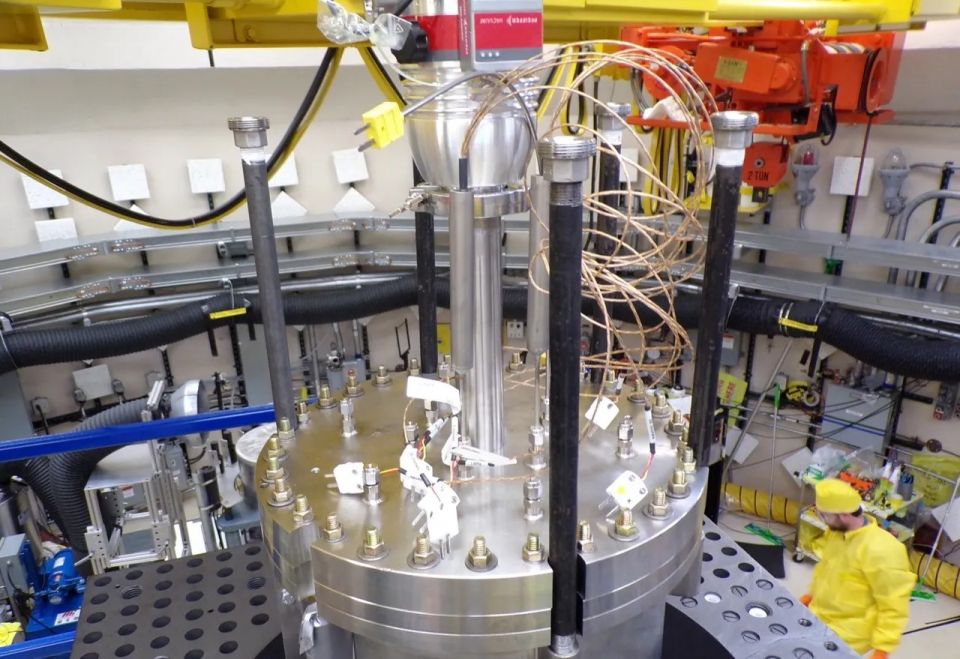
Los Alamos National Laboratory announced last week that its ZiaCore microreactor reached zero-power criticality at high temperatures, completing a four-week series of experiments earlier this year on the Deimos test bed at the National Criticality Experiments Research Center in New Mexico.
The ZiaCore design uses a zirconium hydride moderator paired with heat pipe cooling, and was engineered from the outset to run on materials already available commercially rather than components still in development. The reactor can use low-enriched uranium dioxide fuel, though its design also allows for high-assay low-enriched uranium, or HALEU. LANL said the system is built to scale up or down for different power needs and is expected to run for roughly eight years without refueling.
During the test series, researchers brought the central core to more than 800 degrees Celsius at near-zero power, gathering data on temperature coefficients of reactivity that LANL said will support the broader category of microreactor development beyond ZiaCore itself.
The milestone follows a wave of criticality announcements this summer from companies racing toward a July 4 target under the Department of Energy's Reactor Pilot Program, including Antares, Valar Atomics, and Aalo Atomics, along with Deployable Energy under the related Nuclear Energy Launch Pad initiative. Zero-power criticality marks an early checkpoint that confirms a design's core physics, well short of the licensing and testing required before a reactor can generate power commercially.
The ZiaCore project was funded through LANL's Laboratory Directed Research and Development program with a $5.5 million award over three years, beginning in October 2023.
Source: Nuclear News (American Nuclear Society) -- https://www.ans.org/news/2026-08-03/article-8265/lanls-ziacore-microreactor-reaches-criticality/