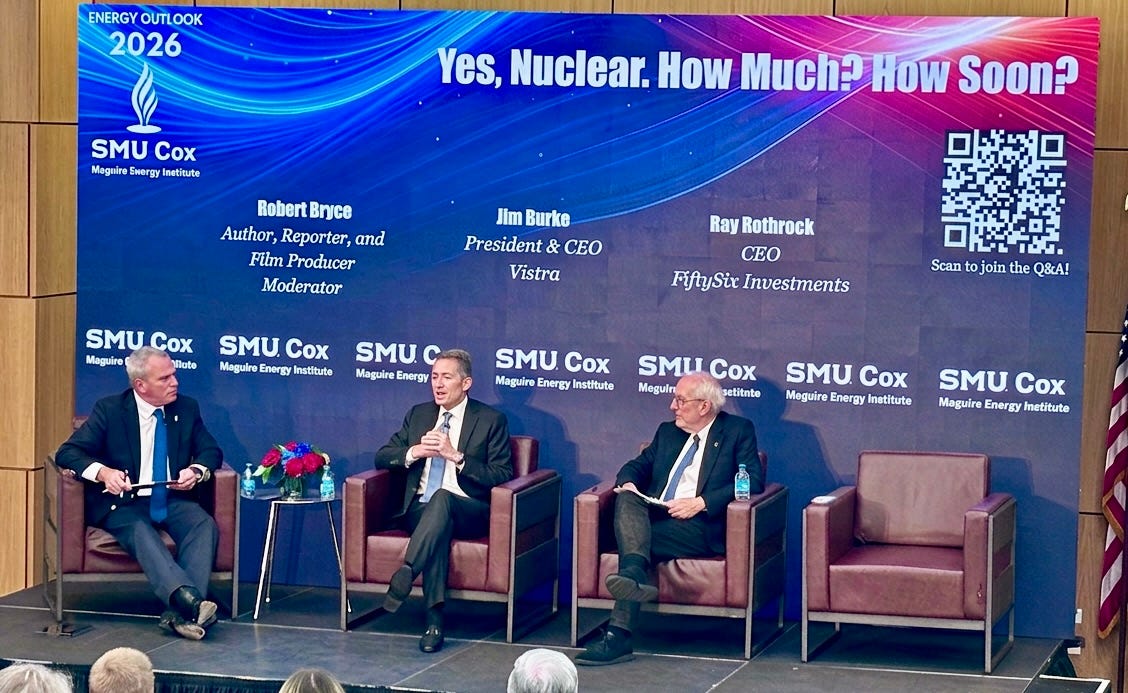
Two of the nuclear industry's most prominent advocates came to SMU Energy Outlook 2026 with a sober near-term assessment: the United States will likely see only 2 to 4 gigawatts of new nuclear capacity by 2035, a fraction of the federal 400-gigawatt target for 2050.
Vistra CEO Jim Burke and investor Ray Rothrock, speaking with energy journalist Robert Bryce, pointed to capital cost as the central obstacle. Capital represents approximately 60 percent of the all-in cost of new nuclear construction. Vogtle illustrated the consequence: interest accumulated during the plant's decade-long construction timeline accounted for 40 percent of the project's final cost.
Burke runs Vistra, which operates 44,000 megawatts across 50 plants and has commitments to grow to 50 gigawatts. Vistra has a 20-year power purchase agreement with Meta for 400 megawatts of nuclear uprate capacity, a direct deal between a hyperscale AI operator and a nuclear generator that bypasses the traditional utility ratemaking process.
The permitting picture improved in March 2026 when the NRC approved TerraPower's Natrium construction permit. New NRC rules under the ADVANCE Act require advanced reactor permit decisions within 24 months, down from the 61 months the NuScale review required. Enrichment capacity remains a structural constraint: roughly 40 percent of U.S. enriched uranium supply has historically come from Russia. Centrus is building an enrichment plant in Ohio to address part of the gap.