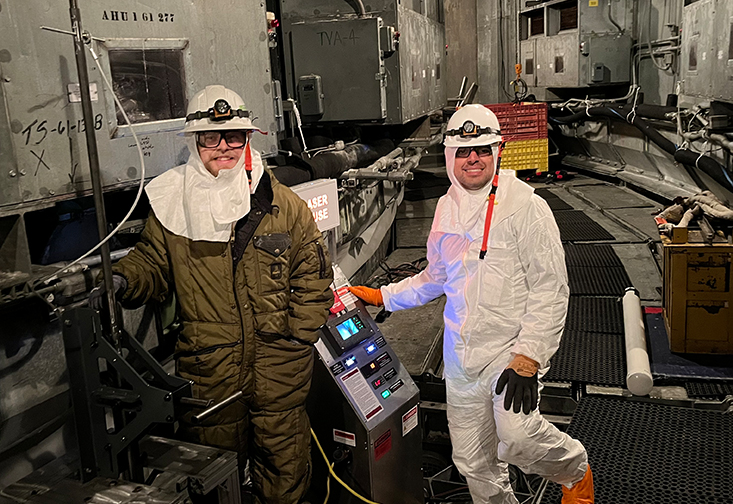
The Tennessee Valley Authority has completed testing of a laser-based maintenance technology developed by engineers at the University of South Florida, aimed at speeding routine inspections of ice condenser systems.
Only a small number of pressurized water reactors worldwide use ice condensers in their containment designs. Two of them are TVA plants in Tennessee: Watts Bar in Spring City and Sequoyah in Soddy-Daisy. Both served as test sites for the new system.
An ice condenser consists of thousands of baskets filled with borated ice. Each basket must be lifted and weighed individually during routine inspection. The process used to replenish gradually melting ice can fuse neighboring baskets together, which previously required labor-intensive work to separate them before inspection could continue.
TVA asked USF to find a better method. Ahmad Vaselbehagh, an associate professor of mechanical and aerospace engineering, and Ty Hagan, a postdoctoral research associate, led a multidisciplinary team that designed a precision laser system to cut through the ice sheets connecting adjacent baskets. The system operates more than 40 feet below the surface in freezing conditions and inside the narrow gaps between baskets.
The laser clears several feet of ice in minutes, cutting maintenance time considerably while allowing inspections to be completed more thoroughly. Testing showed the system works without producing large volumes of meltwater that would refreeze elsewhere.
The USF team completed specialized radiation worker and laser safety certifications and produced operating procedures, documentation, and training materials so plant personnel can run and maintain the equipment on their own.
Vaselbehagh said the project ranked among the most demanding he has led, spanning conceptualization, design, engineering, fabrication, testing, and production of a system that had to work reliably without the research team present. Hagan added that building something for real-world use required mechanical systems, electrical systems, controls, and safety requirements to work together.
Source: American Nuclear Society - https://www.ans.org/news/2026-08-26/article-8339/university-of-south-florida-develops-laser-maintenance-system-for-tva/