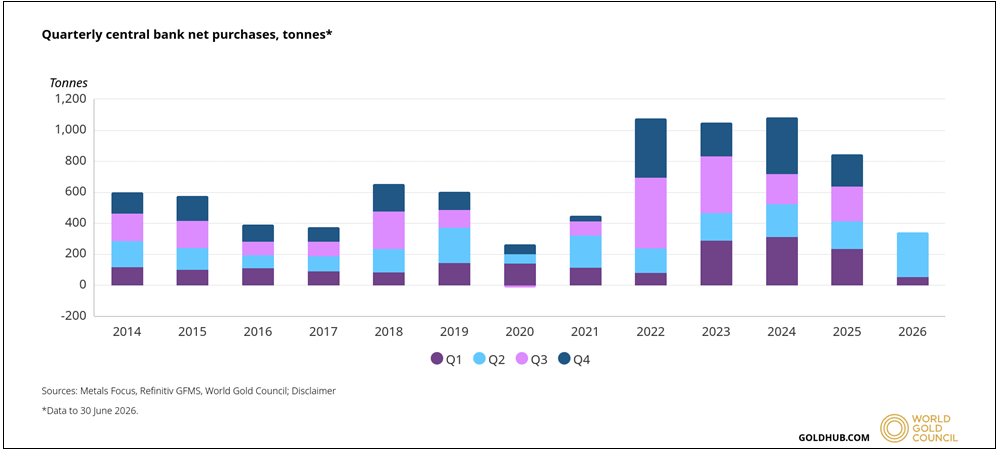
Central banks and other official institutions bought a net 321 tonnes of gold in the third quarter of 2026, a 42 percent increase from a year earlier and the largest quarterly total since the fourth quarter of 2024, according to the World Gold Council's Gold Demand Trends report released November 3. Official sector purchases for the first nine months reached 675 tonnes, up 6 percent.
Total gold demand slipped 1 percent to 1,369 tonnes, while its value rose 22 percent to $188 billion as the gold price averaged $4,262 an ounce. Gold exchange-traded funds took in 211 tonnes worldwide, lifting global holdings to a record 4,256 tonnes. Funds listed in North America added 81 tonnes, reversing weakness in the first half, with buying picking up sharply in August and continuing through September.
U.S. retail investors pulled back. Bar and coin demand in the United States fell 40 percent from a year earlier and 45 percent from the second quarter to about 8 tonnes, the weakest quarter since late 2019. Worldwide bar and coin demand dropped 19 percent to 268 tonnes, with China the main exception.
Jewelry consumption fell 17 percent to 313 tonnes, the weakest third quarter in the council's series, while technology demand rose 3 percent to 85 tonnes. On the supply side, mine production reached a third quarter record of 1,071 tonnes, and recycling fell 8 percent to 314 tonnes.
"The third quarter was a mixed bag for gold demand," said Louise Street, senior markets analyst at the World Gold Council.
The accompanying chart, compiled by the council and published by Sprott, tracks quarterly central bank net purchases from 2014 through June 2026.
Source: World Gold Council -- https://www.gold.org/goldhub/research/gold-demand-trends/gold-demand-trends-q3-2026/investment