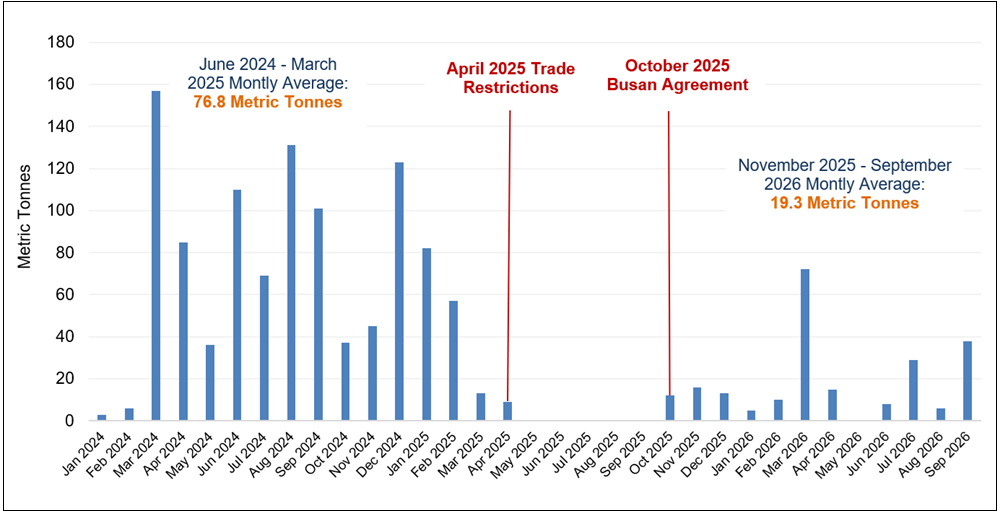
Shipments to the United States of Chinese rare earth compounds and metals covered by China's April 2025 export controls have averaged 19.3 metric tonnes a month from November 2025 through September 2026, according to a November 24 report from Sprott Asset Management. That compares with an average of 76.8 metric tonnes a month from June 2024 through March 2025. Sprott's chart, built on Silverado Policy Accelerator data, shows monthly U.S.-bound volumes falling to zero for several months after the controls took effect.
The report notes that the October 2025 Busan Agreement suspended the strictest proposed controls and averted a total supply cutoff, yet U.S. imports of Chinese rare earths still dropped 75 percent over the following year.
Citing the International Energy Agency, Sprott says China accounts for about 69 percent of rare earth mining, 91 percent of refining and 94 percent of permanent magnet production. China also supplies about 98 percent of refined dysprosium and terbium and 99 percent of samarium oxide, which Sprott identifies as potential bottlenecks for defense applications such as missiles, drones, radar and naval systems.
Prices have split along regional lines. High-purity yttrium oxide trades near $9 a kilogram inside China compared with roughly $1,650 a kilogram in North America, a gap of about 185 times, based on Bloomberg and Benchmark Mineral Intelligence data as of November 17. The report also cites a $110 per kilogram price floor for neodymium-praseodymium set for a major U.S. producer.
Sprott describes a recent selloff in its Sprott Rare Earths Ex-China ETF (REXC) as driven mainly by deleveraging, pointing to continued fund inflows and firm rare earth prices.
Source: Sprott -- https://sprott.com/insights/rare-earths-strategic-scarcity-meets-a-liquidity-driven-reset/