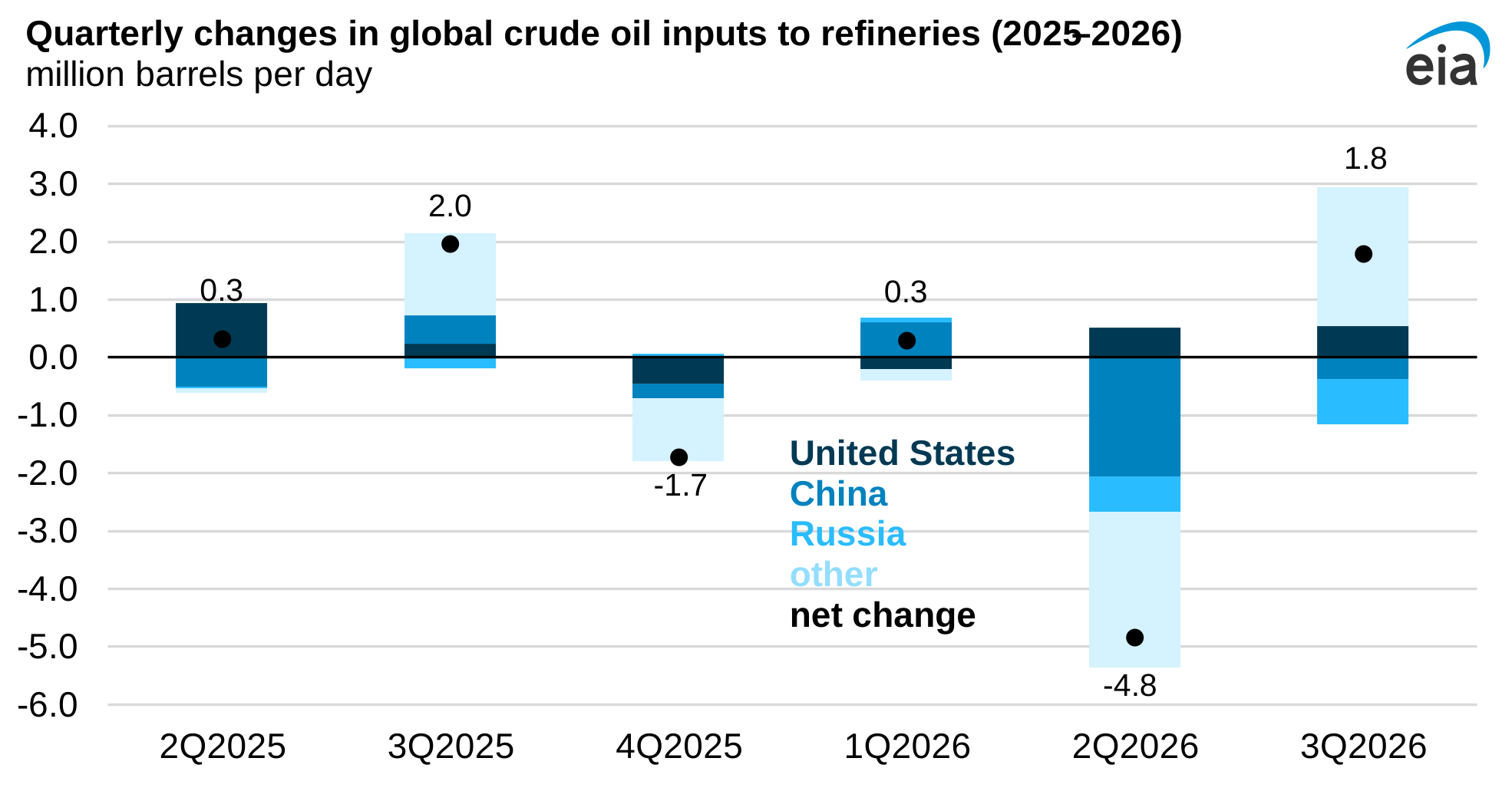
Global crude oil refinery inputs fell by 4.8 million barrels per day, or 6%, in the second quarter of 2026, following the start of conflict in the Middle East in late February, according to Kpler data cited by the U.S. Energy Information Administration. Throughput rose by 1.8 million barrels per day in the third quarter as refiners adjusted to new trade flows. Third quarter inputs remained about 5% below the same period of 2025.
A year earlier, inputs rose by 0.3 million barrels per day in the second quarter and 2 million in the third.
Refining declined most in countries directly affected by lost crude supply through the Strait of Hormuz. Inputs in China fell by 2.1 million barrels per day in the second quarter and by another 0.8 million in the third. India, South Korea and Japan fell by more than 1.0 million collectively in the second quarter before recovering 0.8 million in the third. Inputs in Kuwait, the United Arab Emirates, Saudi Arabia and Iran fell by 0.7, 0.7, 0.3 and 0.2 million barrels per day.
Attacks on Russian oil infrastructure reduced Russian refinery inputs by 0.6 million barrels per day in the second quarter and 0.8 million in the third. Russia is a major diesel exporter, so the drop tightened global diesel markets that were already short. EIA linked the combined losses to nominal diesel prices reaching record highs in September.
US refinery inputs moved the other way, rising by 0.5 million barrels per day in the second quarter and by another 0.5 million in the third. The United States increasingly exported refined products to offset lost supply elsewhere. The EIA chart shows quarterly changes in global crude oil inputs to refineries for 2025 and 2026.
Source: U.S. Energy Information Administration - https://www.eia.gov/todayinenergy/detail.php?id=68404